
.svg)
.svg)
Optimism Survey in Action
A commentary by Dr Anand Kulkarni, Chief Economist, Centre for Optimism
Over the past five years, thousands of people have answered the Centre for Optimism’s question, “What makes you optimistic?” The early findings suggest that optimism is not one thing or another. It is practical, relational, spiritual, existential, economic, future-facing, resilient and active. Some people draw optimism from family and community. Some from faith. Some from progress, innovation, learning or the beauty of life itself and nature. Many people describe optimism as something they do, not just something they feel.
The survey examined three aspects: what makes you optimistic?; what type of optimist are you? (from a range of possibilities); and the linkage between drivers of optimism and the type of optimism.
Drivers of Optimism
|
General Positivity |
36% |
|
Relational |
26.18% |
|
Existential Appreciation |
20.94% |
|
Faith and Belief |
14.52% |
|
Economic |
11.12% |
Note Numbers will not add up to 100 here due to multiple answers.
The data shows that optimism, as reflecting simply who a person is, part and parcel of their very being, is the most significant driver of optimism. It is not related to any particular event or circumstance.
The second most important reason or driver is relational. People derive their optimism from the strength of relationships to family, friends and the broader community. It is embedded in trust networks, emotional and social capital. In some senses, it can be linked to the notion of belonging and place.
Following relational optimism is that of Existential Appreciation in order of importance. This reflects optimism grounded in life itself, existence and importantly gratitude for the experiences of life. It is not based on specific material aspects, expectations of rewards, meeting challenges of the future, but rather is about being alive and experiencing its wonder. Life is meaningful enough to sustain optimism.
Faith also looms as an important driver. This reflects such factors as religious observance, belief systems and spirituality. It provides illumination about order, purpose and underpins resilience. It is connected to a “resilience architecture”.
Interestingly, although important, economic factors do not loom as large. People’s optimism is not necessarily derived from material aspects, promise of advancement, or financial gain. Rather, optimism is grounded more deeply in relationships, meaning, agency and efficacy and faith.
In terms of the type of optimism, what is striking is that “can do optimism” and “realistic optimism” are the two stand out and related categories, as shown in the following pie chart. This reflects optimism that is grounded in practical actions and outcomes and specific activities, based on research and evidence. This is the tangible operation of optimism in practice. It also suggests strongly that optimism can be learned as a strategic and in some cases tactical response. Optimists act- they solve, build, learn, repair and persist.
Types of Optimism
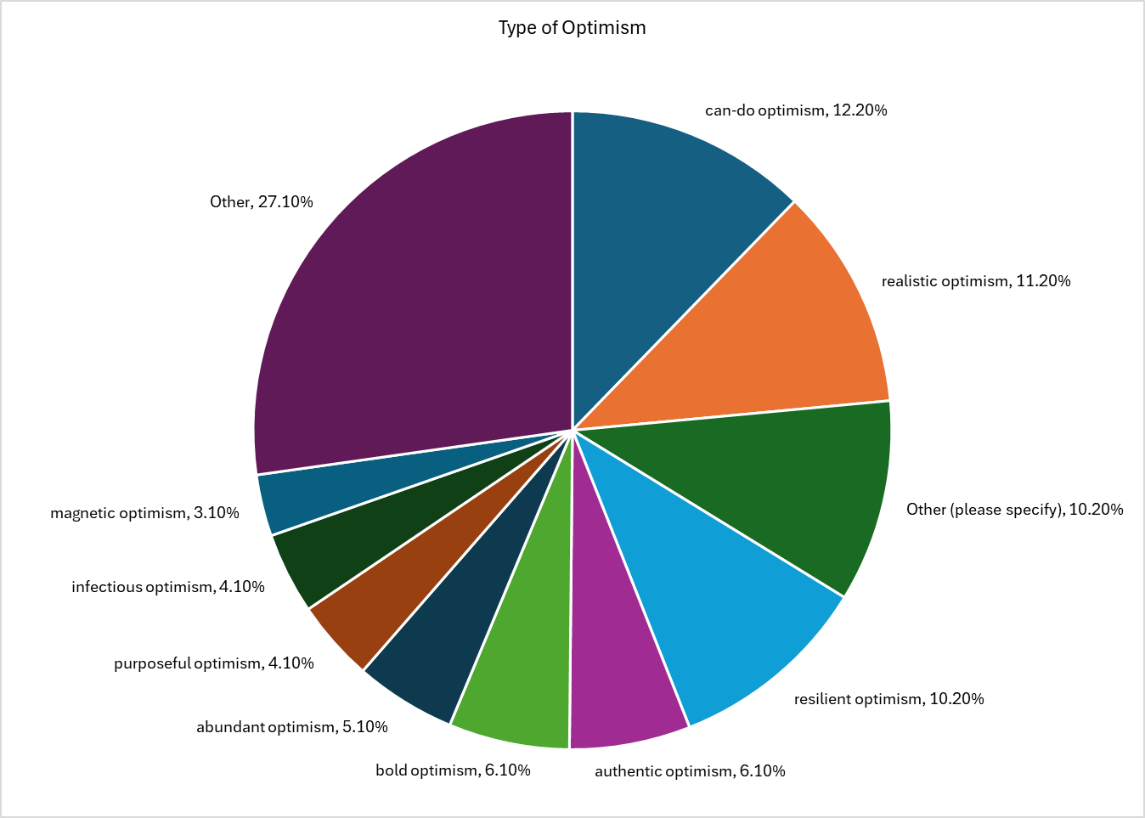
Resilient optimism, the capacity to bounce back from adversity and respond to challenges in a positive manner, is also significant. The ability to bounce back also dovetails with the whole notion of “can do” optimism.
Some respondents confirmed that authentic optimism, bold optimism and abundant optimism are also significant. The latter two belong especially to the realm of vision, growth, future orientation and transformative action. It links clearly with innovation and entrepreneurship.
The survey examined how the driver of optimism maps to the type of optimism. It shows clearly that agency responses such as taking action, maps to “can do” and “realistic optimism”. Those who cite family, friends and loved ones ie relational factors, aligns significantly with infectious and authentic optimism, indicating that optimism has a contagious character, rather than purely derived from internal factors.
A selection of quotes highlights the points being made here, in particular the idea of optimism as action.
“I’ve been labelled a “serial optimist” and it’s a label I like. As the CEO it is my job to be optimistic and to encourage and be encouraged”.
“The ability to remain optimistic and plan ahead in the midst of uncertainty is really important. Focus on the road ahead and not the rear view mirror”.
“Optimism is a happiness magnet. If you stay positive, good things and good people will be drawn to you”.
“During challenging times, whether it be floods, fires, drought or even a virus, I’m always impressed by how a small group of optimistic people will pull together and work as one to achieve an optimal outcome. An outcome energised by the community”.
I would like to invite you to build on this initial research by answering what makes you optimistic and what type of optimism is yours. We are very interested too in studying what’s called the optimism gap - the difference between personal optimism and optimism for the nation. What makes you optimistic about the country you live in?
These responses are vital to further enhancing our understanding of what drives and shapes optimism and to providing a basis for practical action at the personal, community, and national levels.
Please fill in the Survey: What makes you Optimistic?
.png)
.png)
.png)
Keep up to date with the latest from Centre for Optimism
We appreciate any contribution you can make to help us spread optimism with the world


.svg)

.svg)